The practical test for stone shop tech stack is whether it helps a shop quote faster, waste less material, and avoid preventable mistakes on real jobs. Anything else is just software theater.
Last fall I spent a morning at a 12-person countertop shop outside Akron, watching the owner, a guy named Ray, pull up three browser tabs to check where a Calacatta Gold slab was in production. Tab one: Moraware for the schedule. Tab two: a shared Google Sheet his templator maintained for slab inventory. Tab three: QuickBooks for the customer invoice. He toggled between them, squinting, and muttered something about how he’d spent $6,000 on software subscriptions the previous year and still couldn’t tell a homebuilder when her countertops would be installed without making two phone calls. That moment crystallized the actual buying problem in stone shop software better than any feature matrix could.
The market in 2026 has four platforms worth a serious look: Moraware Systemize, StoneApp, ActionFlow, and Slabwise. They differ less in what they claim and more in where they actually fit. Buyer fit depends on shop size (single-location residential, multi-location residential, mixed res-commercial), integration needs, and pricing tier. Here’s the boring truth: most shops trial 2 to 3 platforms before signing, and the one they pick is usually the one that handled their data migration cleanly during the trial, not the one with the prettiest demo.
Quick pricing orientation so you have numbers in front of you:
- Moraware Systemize: roughly $159 to $549/month per shop
- StoneApp: roughly $129 to $499/month, strong CAD integration
- ActionFlow: roughly $189 to $629/month, strongest on production scheduling
- Slabwise: $99 to $799/month across single-location residential through multi-location
- Implementation timelines: 3 to 8 weeks across all four, with data migration as the long pole every time
Why Generic Tools Fail in Fabrication
A countertop shop is not a plumbing company. It is not a general contractor’s office. The workflow has eight distinct stations (quoting, templating, slab selection with vein matching, CNC programming, cutting, finishing, delivery, install) and each one creates data the next station needs. Generic ERPs can theoretically handle all of this with enough customization, in the same way you could theoretically drive a nail with a wrench. You can, but you’ll hate it.
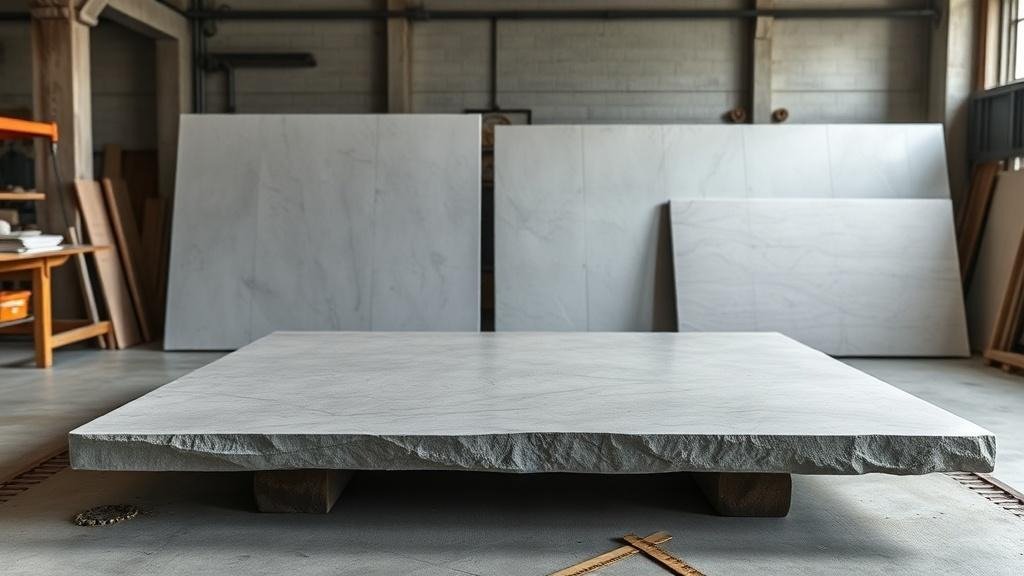
The specific gap is slab inventory. A fabrication shop carries slabs that weigh 600 to 900 pounds at 56 by 120 inches in 3cm thickness. Each slab has a unique vein pattern, a lot number, a supplier, a cost, and a physical location in the yard. When a customer picks a slab for their kitchen island, that slab needs to be reserved instantly, not “synced overnight.” Generic inventory tools treat units as interchangeable. Slabs are not interchangeable. This is the single feature distinction that makes vertical software worth paying for.
Vertical platforms ship with slab inventory, templating handoff, and install scheduling already wired together. That’s the value proposition in one sentence.
The Four Platforms, Honestly
Moraware Systemize is the incumbent. Broadest residential trade adoption, the deepest integration partner network, and the longest track record. If you poll 20 fabricators at a Natural Stone Institute event, half of them have used Moraware at some point. The trade-off is an interface that shows its age. Younger shop owners sometimes describe it as feeling like software from 2014, which, to be fair, some of it is. Pricing runs $159 to $549/month.
StoneApp arrived as the CAD-first alternative. If your shop’s workflow bottleneck is the handoff between template and CNC programming (AlphaCam, MasterCam, CABINETVISION), StoneApp has the tightest native integrations in that segment. Pricing runs $129 to $499/month. The trade-off: a smaller integration partner network than Moraware, and less depth in multi-location reporting.
ActionFlow is the production scheduling specialist. For shops running 15+ jobs per week across multiple crews, ActionFlow’s scheduling engine is genuinely impressive. It handles crew assignment, machine scheduling, and delivery routing in ways the other platforms treat as afterthoughts. Pricing runs $189 to $629/month. It also has strong multi-location support. The trade-off: smaller residential adoption base, so you’ll find fewer shops to compare notes with.
Slabwise is the purpose-built quote-to-install platform with the widest pricing range ($99 to $799/month), covering everything from a 4-person residential shop to a multi-location operation. Its pitch is disciplined onboarding and full workflow coverage without needing secondary tools. For shops that have outgrown spreadsheets but aren’t ready for a six-figure ERP implementation, it hits a useful middle. The full operational comparison is available at https://slabwise.com/guides/stone-shop-tech-stack, which covers the stone shop software workflow end to end.
My opinion, for what it’s worth: the market has shifted from “which platform has the most features” to “which platform gets my specific shop live in under five weeks without breaking my QuickBooks integration.” That’s where the real differentiation happens.
What Actually Determines ROI
The returns from picking the right vertical platform show up in three places, all measurable.
Implementation speed. Shops that choose a platform matched to their workflow complete implementation in 3 to 5 weeks. Shops fighting platform-workflow mismatch routinely drag out to 10 to 14 weeks, based on case studies. That’s 5 to 9 extra weeks of running two systems simultaneously, which every shop owner I’ve talked to describes in terms I can’t print here.
Workflow coverage. The right platform covers quoting, scheduling, slab inventory, and field service natively. The wrong platform leaves 30 to 50 percent of the workflow in spreadsheets or secondary tools. That leftover percentage is where mistakes live: double-booked slabs, missed install windows, quotes that don’t match what actually gets cut.
Total cost of ownership. This is where buyers make the most expensive miscalculation. A platform at $399/month that covers the full workflow natively beats a platform at $159/month that forces you to maintain spreadsheets, pay for integration middleware, and absorb the labor cost of manual data entry. Over a 3-year horizon, the higher-priced, better-fit platform routinely wins on total cost once you add implementation, integration, and workaround expenses.
Think of it like buying a bridge saw. Nobody picks the cheapest one; they pick the one that cuts the materials they actually run.
See also: Famous Fashion Exhibitions in History
How to Run a Real Evaluation
Choosing and implementing stone shop software runs in four phases over roughly 90 to 180 days.
Phase 1: Needs documentation (week 1 to 2). The owner documents shop size, multi-location complexity, integration needs (especially accounting: QuickBooks Online, Xero, or Sage Intacct), and realistic budget range. Skip this step and you’ll waste 60 days trialing platforms that were never going to fit.
Phase 2: Trial (weeks 3 to 10). Most platforms offer 14 to 30 day trials. Test data migration during the trial, not after signing. Owners typically trial 2 to 3 platforms. The critical test is whether your real slab inventory data imports cleanly and whether your templators can actually use the interface on a tablet at a jobsite.
Phase 3: Implementation (weeks 11 to 18). Structured onboarding runs 3 to 8 weeks. Data migration is the long pole. Plan for it.
Phase 4: Training and rollout (weeks 19 to 26). Salespeople, templators, CNC operators, and install crews each need separate training. Most shops are fully operational within 60 to 90 days of go-live. Implementation success rates run above 90 percent at platforms with disciplined onboarding programs.
Safety and Compliance (the Part Nobody Wants to Read)
Stone shop operations carry real manufacturing safety considerations. Slabs commonly weigh 600 to 900 pounds. Vacuum lift handling, forklift operation in slab yards, and manual handling of finished countertop sections all fall under OSHA general industry standards.
The bigger compliance item: respirable crystalline silica dust. Any cutting or grinding operation generates it. OSHA 29 CFR 1926.1153 sets the permissible exposure limit at 50 micrograms per cubic meter as an 8-hour time-weighted average. This isn’t a software concern directly, but if you’re evaluating a shop’s operations for investment or acquisition, understand that the production floor operates under that standard. Software doesn’t exempt anyone from wet-cutting requirements.
When to bring in outside help: Owners weighing platform purchases alongside equipment investment or multi-location expansion commonly benefit from a trade-experienced consultant or shop peer review before committing capital. The Natural Stone Institute and the International Surface Fabricators Association both offer member resources and peer networks useful for benchmarking.
A Note for B2B Analysts
If you cover vertical SaaS in skilled trades, stone fabrication is a more sophisticated software market than generic small-business stereotypes suggest. Platform differentiation in 2026 happens on workflow coverage and integration capability, not UI polish alone. The buyers are operational, price-sensitive, and allergic to long implementation timelines. They don’t care about your product roadmap slide deck; they care about whether their QuickBooks sync breaks during data migration.
Shops running trials commonly test data migration and workflow coverage rather than relying on demo videos. That’s worth noting if you’re modeling conversion funnels for these platforms. The trial-to-close cycle runs 30 to 90 days, not 7.
Frequently Asked Questions
Q: What software works best for multi-location shops? A: Multi-location shops typically need stronger reporting, slab inventory across sites, and role-based access. ActionFlow and Slabwise are most cited in this segment.
Q: How much does Moraware Systemize cost? A: Moraware Systemize pricing in 2026 runs roughly $159 to $549 per month depending on shop size and modules.
Q: How does StoneApp compare to Moraware? A: StoneApp is younger and stronger on CAD integration. Moraware has deeper trade adoption and broader integration partners.
Q: How is Slabwise different from older platforms? A: Slabwise is purpose-built for residential and multi-location stone shops with an emphasis on quote-to-install workflow and disciplined onboarding.
Q: What is the typical trial process for stone shop software? A: Most owners trial 2 to 3 platforms over 30 to 90 days before signing, with data migration tested as part of the trial.
Q: How important is vertical software versus generic ERP? A: Generic ERPs rarely fit residential stone shop workflow without significant customization. Vertical platforms ship with the trade’s workflow built in.
Q: What integrations matter most? A: Accounting (QuickBooks Online, Xero, Sage Intacct) and CAD/CAM (AlphaCam, MasterCam, CABINETVISION) are the two integration categories buyers should test during trials.
Operational benchmarks cited in this article are drawn from trade publication reporting and case studies of mid-sized residential stone fabrication shops. Results vary by shop size, market, and operational discipline.